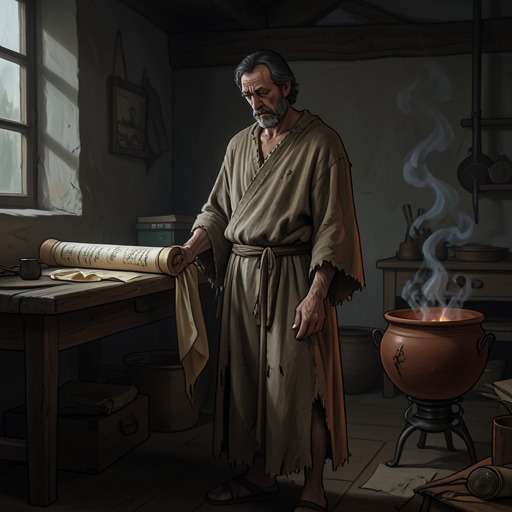
Xuande–Cao Cao rivalry
The Romance of the Three KingdomsXuande–Cao Cao rivalry is a central political and military conflict in the novel, joining the fortunes of two leading contenders to the collapse of the Han. Cao Cao’s control of the emperor gives him the instruments and authority of the old court; Xuande’s allegiance to the Han and reputation for benevolence support a rival claim to rule. Their struggle is therefore not only a contest between armies: it asks whether power is justified by command of the state or by the promise of restoring just government.
Origins and Competing Claims
The rivalry takes shape in a world where the Han government is disintegrating and warlords carve kingdoms from its ruins. Xuande, Cao Cao, and Sun Quan emerge as the three leaders who eventually establish rival dynasties. Xuande’s fortunes shape the early movement of the story, while the conflict between him and Cao Cao becomes one of its defining antagonisms.
The novel presents the two men as politically opposed in both character and position. Cao Cao is ambitious and ruthless, and he turns even an early conflict within his family to his advantage: after his uncle complains about his conduct and Cao Cao is punished, he later pretends to collapse in front of that uncle and tells his father that nothing happened. His father thereafter dismisses the uncle’s criticism. The anecdote introduces a capacity for deception that recurs in Cao Cao’s exercise of power.
Cao Cao’s most consequential advantage is his control of the Han emperor. He holds Emperor Xian under elaborate house arrest and uses the imperial authority attached to the emperor to advance his own political position. Xuande’s claim runs in another direction. His distant connection to the imperial family allows him to present himself as a defender of the Han even though the dynasty has effectively fallen. The contrast between the men’s claims becomes explicit when Kong Ming later argues that Cao Cao has usurped the true ruler and urges Xuande to assume the throne in the name of Heaven and the people.
Rivalry as Political Strategy
After Cao Cao has settled in Xuchang and tightened his hold over the emperor, he becomes concerned by the possibility that Xuande and Lü Bu might combine against him. His adviser Xun Wenruo proposes exploiting their mistrust: the emperor will promote Xuande but secretly order him to kill Lü Bu. If Xuande obeys, Cao Cao benefits; if he fails, Lü Bu may kill him. Cao Cao sends the commission and secret command to Xuande in Xuzhou.
Xuande accepts the promotion but refuses to act on the secret order. Zhang Fei, who hates Lü Bu, blurts out the scheme when Lü Bu comes to congratulate Xuande. Xuande drives Zhang Fei from the room and assures Lü Bu that he will not carry out the command. When Guan Yu and Zhang Fei later demand an explanation, Xuande explains that he has recognized Cao Cao’s design. The episode makes the rivalry a contest of political judgment as well as force: Cao Cao seeks to turn his opponents against one another, while Xuande’s refusal preserves his freedom of action and avoids making Cao Cao’s plot succeed.
Xun Wenruo proposes a second deception when he learns Xuande has not killed Lü Bu. Cao Cao should inform Yuan Shu that Xuande has secretly requested permission to attack him, provoking Yuan Shu to strike first; Cao Cao could then authorize Xuande to retaliate. Conflict between Xuande and Yuan Shu would leave Lü Bu uncertain whom to trust. When the new imperial message reaches Xuande, his adviser Mi Zhu recognizes another trap. Xuande nevertheless treats it as an imperial command and prepares to attack Yuan Shu.
The orders also expose tensions within Xuande’s own camp. Guan Yu is needed for the campaign, and Zhang Fei volunteers to take charge of Xuzhou. Xuande rejects the proposal, citing Zhang Fei’s drinking, his tendency to attack people while drunk, and his habit of disregarding advice. Zhang Fei promises to stop drinking and beating people, but Xuande still leaves Chen Deng in charge and instructs him to watch Zhang Fei. The rivalry with Cao Cao thus affects not only relations between opposing rulers but the allocation of command and trust within Xuande’s household and army.
Armies, Deception, and Unequal Strength
Their conflict is repeatedly measured in material as well as political terms. At Guandu, Yuan Shao brings a huge army while Cao Cao can muster only about one-tenth as many troops. Cao Cao’s adviser Xun You presses for an immediate attack because Cao Cao’s soldiers are veterans but their supplies are limited; a prolonged campaign would exhaust them. The confrontation turns the rivalry into a larger struggle for supremacy, in which readiness and supply constrain the use of military strength.
The novel also shows how closely Cao Cao’s fortunes depend on reading an opponent’s intentions—and how that reading can be turned against him. During the conflict with Zhang Xiu, Jia Xu observes that Cao Cao appears to be watching the southeastern section of the city wall, whose crumbling earthworks and wooden stakes make it seem vulnerable. Yet Cao Cao has piled materials on the northwest side to suggest that he will attack there. Jia Xu recommends reversing the deception: hide Zhang Xiu’s best troops near the southeastern breach and place ordinary people in armour on the northwest wall. This episode illustrates the strategic world in which Cao Cao and Xuande contend, where apparent weakness, concealed preparations, and an adversary’s expectations can matter as much as numbers.
At Bowang, Xuande’s newly appointed strategist Kong Ming puts this style of warfare to the test against Cao Cao’s advancing army. He assigns Guan Yu to wait in the hills and attack the rear and supply train when flames appear; Zhang Fei is to strike the army’s stores at Bowang; troops are prepared to start fires on either side of a ravine; and Zhao Zilong is instructed to feign retreat after meeting the enemy. Guan Yu and Zhang Fei doubt the plan, particularly because Kong Ming will not be near the fighting. Xuande rebukes them and follows Kong Ming’s orders. The planned attacks make the confrontation a trial of Xuande’s willingness to trust a strategist whom his sworn brothers distrust, rather than simply a direct clash between the two rival leaders.
A later episode sharpens the pattern of competing intelligence. During the dense fog, Kong Ming sends boats towards Cao Cao’s shore. Cao Cao hears what sounds like an attack and orders his archers and crossbowmen to fire into the fog; the narrator says ten thousand men shoot in response. The boats carry bales of straw wrapped in black, which collect the arrows. As the fog lifts, Kong Ming takes the boats back with the arrows they have gathered. Cao Cao’s defensive response, intended to repel an assault, supplies his opponent with what he needs. In this episode the rivalry is dramatized through a reversal: Cao Cao’s command is powerful, but Kong Ming determines what that power accomplishes.
Legitimacy and Historical Meaning
Kong Ming gives the rivalry its clearest political interpretation when he advises Xuande on the future of the Han. He describes Cao Cao as too strong to oppose directly because he commands a vast army and controls the emperor, thereby attracting the allegiance of many nobles. Xuande, by contrast, should regard Sun Quan as a potential ally and look towards Jingzhou. The advice frames Xuande’s prospects in terms of coalition and political position as well as personal virtue; resisting Cao Cao requires recognizing the practical limits imposed by his control of the court.
After the gains in Hanzhong, Kong Ming presses Xuande to become emperor. He argues that Cao Cao has seized so much power that the true ruler has been displaced, while Xuande is renowned for benevolence, has brought peace to the regions under his control, and possesses Shu. Xuande objects that, despite his Han lineage, taking the throne may make him appear to be a rebel. Kong Ming answers that the land has already been torn apart by those who seize power and that loyal and virtuous people want a true emperor. The exchange shows how each side of the rivalry is bound to the question of legitimate rule: Cao Cao wields imperial authority through his custody of the emperor, while Xuande is urged to claim authority through Han descent, public support, and the restoration of order.
The rivalry also belongs to the novel’s transformation of history into dramatic memory. Its historical events provide a foundation, but the book combines that material with oral storytelling, theatre, and poetry. Anonymous poems often summarize events in a manner associated with performance, and the novelist’s synthesis turns historical antagonism into a continuing dramatic structure. The conflict between Cao Cao in the north and Xuande in the west and south is presented as an opposition through which the book illuminates the wider collapse of the Han and the emergence of competing kingdoms. Their rivalry thus carries the novel’s central political question: in a broken empire, what kind of claim can make power worthy of allegiance?